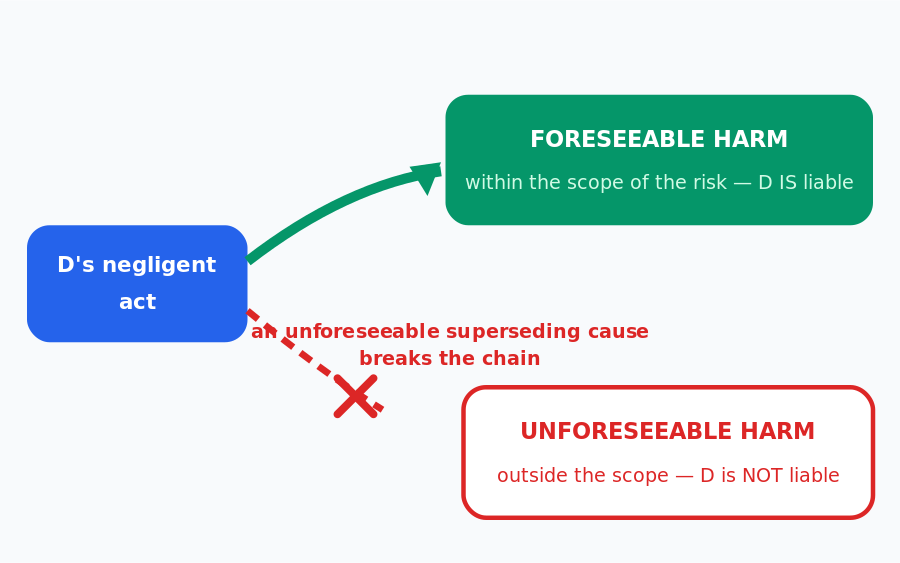
Was the plaintiff's harm a foreseeable result of the defendant's negligence?
這一課問的是:P 的損害是否為 D 過失的「可預見結果」 —— 過失四要件的第四關。
ActorActObjectStandardConsequence
① Visual Scene
Proximate Cause
本課的視覺化圖 — 同一套五色 Visual Grammar 表達核心結構。
Notice the diagram uses the same five-role colour grammar — Actor, Act, Object, Standard, Consequence.
② Core Terms
7 words you must own
本課術語。點擊卡片翻面看法律含義。
Tap a card to flip it.
③ Issue Meaning
What does this topic ask?
這一課問的是:P 的損害是否為 D 過失的「可預見結果」 —— 過失四要件的第四關。
"Proximate Cause" really asks: Was the plaintiff's harm a foreseeable result of the defendant's negligence?
Trigger words 觸發詞 — see these, think "Proximate Cause":
foreseeable resultscope of the riskintervening causesuperseding causetoo remotefreak event
④ Expression Bank
How lawyers say it
不只是認識單詞,而是知道律師怎麼把它說出來。讀出聲音。
⑤ Rule Sentence
One exam-ready rule
先看 Core(核心要件),再切到 Full(完整考試句)。
A defendant is the proximate cause of harm that is a foreseeable result of the defendant's negligence — harm within the scope of the risk the negligence created.; a foreseeable intervening cause does not break the chain, but an unforeseeable, superseding cause cuts off the defendant's liability.
Source: Legal English for U.S. Law · Torts Production Standard v1.0
⑥ Sentence Anatomy
Five colored parts — always
把規則句拆成 5 個彩色零件 — 同一套顏色,貫穿 16 科每一節 lesson。
Actor 行為人
a defendant whose negligence is tested
被測之 D
Act 行為
the negligent act setting events in motion
啟動事件之過失行為
Object 對象
the plaintiff's harm
P 之損害
Standard 法律標準
foreseeability · scope of the risk
可預見性 / 風險範圍
Consequence 後果
proximate cause established (or cut off by superseding)
近因成立(或被取代切斷)
同一套五個零件在 16 科每一句 rule 裡重複出現。
⑦ Casebook Snapshot
How U.S. courts teach this
美國法學院用案例教學。每節課看一個經典案例,只看法官最核心的 holding。
Overseas Tankship (U.K.) Ltd. v. Morts Dock & Engineering Co.
Privy Council, 1961 · "The Wagon Mound (No. 1)"
Simplified Holding
A negligent defendant is liable only for harm of a kind that was reasonably foreseeable; liability does not extend to consequences that were not foreseeable, even though the defendant's conduct was careless.
Why It Matters Here
Proximate cause limits liability to the foreseeable. Carelessness alone does not make a defendant answer for a freak, unforeseeable result.
近因把責任限縮到可預見之損害。
This is a simplified statement of the court's holding, written for study — not a quotation.
⑧ Mini IRAC
Your first legal analysis
用 IRAC 四步做最小法律分析。選出空格裡正確的詞。
Issue 法律問題
Was D the proximate cause of P's broken leg when D's careless driving caused the collision?
Rule 規則
A defendant is the proximate cause of harm that is a foreseeable result of the defendant's negligence.
Application 適用
D drove carelessly and crashed into P's car, breaking P's leg. Because a defendant is the proximate cause of harm foreseeably resulting from the negligence, the fact that a broken leg is an obviously result of a careless car crash means P's harm fell squarely within the scope of the risk D's careless driving created.
Conclusion 結論
Therefore, D was the proximate cause of P's harm.
Application formula: Because [rule], the fact that [legalized fact] means [legal significance]. Always say what the fact means in law.
⑨ Common Mistakes
Where Chinese learners slip
這些是中文母語學習者最常踩的坑。
proximate cause 和 actual cause 是同一件事。
Actual asks 'in fact'; proximate asks 'foreseeable scope'.
前事實,後範圍。
D 只要是 but-for cause 就一定要負責。
Harm must also be a foreseeable result.
還須通過可預見性。
任何後續事件都會切斷 D 的責任。
Only unforeseeable superseding causes cut off.
只有不可預見的取代原因切斷。
proximate 是「距離近、時間近」。
Proximate is about foreseeability, not physical/temporal closeness.
看的是可預見性,不是物理時間遠近。
⑩ MBE Check
One quick multiple-choice check
用一道選擇題檢查你是否抓住了核心規則。
D negligently left a metal ladder lying across a public sidewalk. An unforeseeable bolt of lightning struck the ladder, and the freak electrical surge injured P, who was passing by. Is D a proximate cause of P's injury?
⑪ Mini Essay
Write one IRAC paragraph
寫一段 IRAC。寫完後再展開 model answer 對照。
Facts
D, a store owner, negligently left a wet patch on the floor with no warning sign. P slipped on the wet floor and broke her wrist.
Call
Was D the proximate cause of P's broken wrist?
Your Task
Write one short IRAC paragraph — Issue, Rule, Application, Conclusion.
Issue
The issue is whether the facts satisfy the rule for Proximate Cause.
Rule
A defendant is the proximate cause of harm that is a foreseeable result of the defendant's negligence — harm within the scope of the risk the negligence created.
Application
D left a wet, unmarked patch on the store floor, and P slipped and broke her wrist. Because a defendant is the proximate cause of harm foreseeably resulting from the negligence, the fact that slipping and a broken wrist are exactly the kind of harm an unmarked wet floor makes foreseeable means P's harm fell within the scope of the risk D created.
Conclusion
Therefore, D was the proximate cause of P's broken wrist.