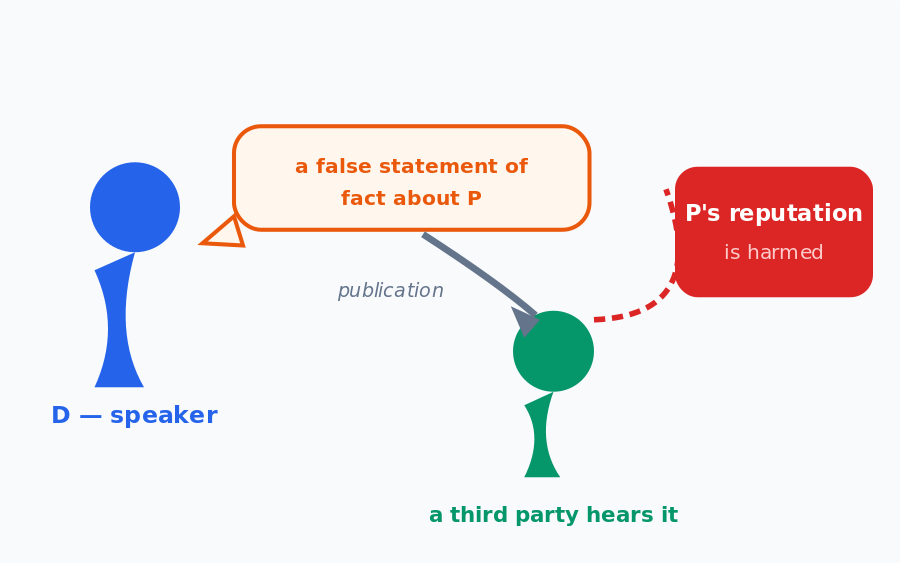
Did the defendant publish a false statement of fact that harmed the plaintiff's reputation?
這一課問的是:D 是否向第三人發表了關於 P 的虛假事實陳述,並損害了 P 的名譽。
ActorActObjectStandardConsequence
① Visual Scene
Defamation
本課的視覺化圖 — 同一套五色 Visual Grammar 表達核心結構。
Notice the diagram uses the same five-role colour grammar — Actor, Act, Object, Standard, Consequence.
② Core Terms
7 words you must own
本課術語。點擊卡片翻面看法律含義。
Tap a card to flip it.
③ Issue Meaning
What does this topic ask?
這一課問的是:D 是否向第三人發表了關於 P 的虛假事實陳述,並損害了 P 的名譽。
"Defamation" really asks: Did the defendant publish a false statement of fact that harmed the plaintiff's reputation?
Trigger words 觸發詞 — see these, think "Defamation":
said that Ptold otherspublishedpostedfalse statementruined P's reputation
④ Expression Bank
How lawyers say it
不只是認識單詞,而是知道律師怎麼把它說出來。讀出聲音。
⑤ Rule Sentence
One exam-ready rule
先看 Core(核心要件),再切到 Full(完整考試句)。
Defamation requires the defendant's publication, to a third party, of a false statement of fact, of and concerning the plaintiff, that is defamatory and tends to harm the plaintiff's reputation.; libel is written or recorded and slander is spoken, and where the plaintiff is a public official or public figure the plaintiff must also prove actual malice — knowledge of falsity or reckless disregard of the truth.
Source: Legal English for U.S. Law · Torts Production Standard v1.0
⑥ Sentence Anatomy
Five colored parts — always
把規則句拆成 5 個彩色零件 — 同一套顏色,貫穿 16 科每一節 lesson。
Actor 行為人
the defendant
作出陳述者
Act 行為
publication to a third party
向第三人發表
Object 對象
the plaintiff's reputation
P 之名譽
Standard 法律標準
a false, defamatory statement of fact
虛假之誹謗性事實陳述
Consequence 後果
defamation liability
誹謗責任
同一套五個零件在 16 科每一句 rule 裡重複出現。
⑦ Casebook Snapshot
How U.S. courts teach this
美國法學院用案例教學。每節課看一個經典案例,只看法官最核心的 holding。
New York Times Co. v. Sullivan
United States Supreme Court, 1964 · the civil-rights advertisement case
Simplified Holding
A public official cannot recover for a defamatory falsehood about official conduct unless the official proves the statement was made with actual malice — knowledge that it was false, or reckless disregard of whether it was false.
Why It Matters Here
Public figures face a heavier burden — proof of actual malice — to protect free speech.
公眾人物原告須證明實際惡意,以保障言論自由。
This is a simplified statement of the court's holding, written for study — not a quotation.
⑧ Mini IRAC
Your first legal analysis
用 IRAC 四步做最小法律分析。選出空格裡正確的詞。
Issue 法律問題
Did D defame P by telling P's colleagues that P had stolen from the company?
Rule 規則
Defamation requires publication to a third party of a false statement of fact, of and concerning P, that is defamatory and tends to harm P's reputation.
Application 適用
D told several of P's colleagues that P had stolen money from the company, which was untrue. Because defamation requires the publication of a that harms reputation, the fact that means D published a defamatory falsehood that lowered P in the eyes of the community.
Conclusion 結論
Therefore, D defamed P.
Application formula: Because [rule], the fact that [legalized fact] means [legal significance]. Always say what the fact means in law.
⑨ Common Mistakes
Where Chinese learners slip
這些是中文母語學習者最常踩的坑。
純粹的「意見」也能構成誹謗。
Defamation requires a statement of fact, not pure opinion.
須事實陳述,非意見。
只對 P 本人說也算 publication。
Publication requires communication to a third party.
發表須傳達給第三人。
陳述是真的也可能要負誹謗責任。
Truth is a complete defense.
真實是完整抗辯。
每個原告都要證明 actual malice。
Only public officials/figures must prove actual malice.
只有公職人員/公眾人物須證明實際惡意。
⑩ MBE Check
One quick multiple-choice check
用一道選擇題檢查你是否抓住了核心規則。
Angry at P, D writes P a private letter — seen by no one else — falsely calling P a thief. Has D defamed P?
⑪ Mini Essay
Write one IRAC paragraph
寫一段 IRAC。寫完後再展開 model answer 對照。
Facts
At a community meeting, D announced to the crowd that P, a local shopkeeper, secretly waters down the milk he sells. The statement was false. Customers heard it and stopped shopping at P's store.
Call
Did D defame P?
Your Task
Write one short IRAC paragraph — Issue, Rule, Application, Conclusion.
Issue
The issue is whether the facts satisfy the rule for Defamation.
Rule
Defamation requires the defendant's publication, to a third party, of a false statement of fact, of and concerning the plaintiff, that is defamatory and tends to harm the plaintiff's reputation.
Application
D announced to a crowd a false statement that P waters down the milk he sells, and customers then stopped shopping at P's store. Because defamation requires the publication of a false statement of fact that harms reputation, the fact that D communicated this false factual accusation to many third parties — and P lost customers — means D published a defamatory falsehood that harmed P's reputation.