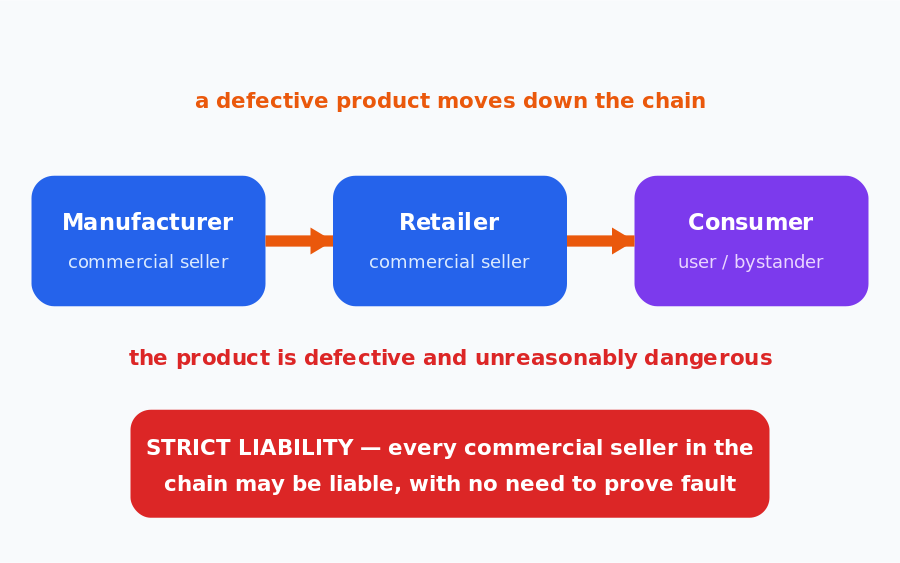
A commercial seller is strictly liable for physical harm caused by a product that was defective and unreasonably dangerous when it left the seller's control.; the defect may be a manufacturing defect, a design defect, or a failure to warn, and every commercial seller in the distribution chain may be held liable regardless of fault.
Source: Legal English for U.S. Law · Torts Production Standard v1.0
⑥ Sentence Anatomy
Five colored parts — always
把規則句拆成 5 個彩色零件 — 同一套顏色,貫穿 16 科每一節 lesson。
Actor 行為人
a commercial seller
商業賣方
Act 行為
placing a product on the market
將產品投放市場
Object 對象
the user, consumer, or bystander harmed
受害之使用者/消費者/旁觀者
Standard 法律標準
defective and unreasonably dangerous
有缺陷且不合理危險
Consequence 後果
strict liability, regardless of fault
嚴格責任,不問過錯
同一套五個零件在 16 科每一句 rule 裡重複出現。
⑦ Casebook Snapshot
How U.S. courts teach this
美國法學院用案例教學。每節課看一個經典案例,只看法官最核心的 holding。
Greenman v. Yuba Power Products, Inc.
California Supreme Court, 1963 · the power-tool case
Simplified Holding
A manufacturer is strictly liable in tort when an article it places on the market, knowing it will be used without inspection for defects, proves to have a defect that causes injury; the injured user need not prove negligence.
Why It Matters Here
Products liability does not run on fault. Once the product is defective and dangerous, the commercial seller answers for the harm.
產品責任不靠過錯;商業賣方對有缺陷的產品負責。
This is a simplified statement of the court's holding, written for study — not a quotation.
⑧ Mini IRAC
Your first legal analysis
用 IRAC 四步做最小法律分析。選出空格裡正確的詞。
Issue 法律問題
Is a manufacturer strictly liable when a defectively built power drill injured the user?
Rule 規則
A commercial seller is strictly liable for harm caused by a product that was defective and unreasonably dangerous when it left the seller's control.
Application 適用
M manufactured a power drill whose handle snapped during ordinary use, injuring P. Because a commercial seller is for harm caused by a product defective and unreasonably dangerous when it left the seller's control, the fact that the drill left the factory with a handle that broke under normal use means it .
Conclusion 結論
Therefore, M is strictly liable for P's injury, and P need not prove M was careless.
Application formula: Because [rule], the fact that [legalized fact] means [legal significance]. Always say what the fact means in law.
⑨ Common Mistakes
Where Chinese learners slip
這些是中文母語學習者最常踩的坑。
P 必須證明賣方有疏忽。
"Strict" means no proof of negligence required.
「strict」就是無需證明過錯。
只有製造商才負責。
Every commercial seller in the chain — manufacturer, distributor, retailer.
分銷鏈上每一商業賣方都可能負責。
偶然賣二手物的私人也負嚴格責任。
Only commercial sellers — those in the business.
只有以銷售為業者適用。
只要產品造成傷害就算 defective。
Must be defective AND unreasonably dangerous.
須有缺陷且具不合理危險。
⑩ MBE Check
One quick multiple-choice check
用一道選擇題檢查你是否抓住了核心規則。
P buys a ladder from a hardware store. A rung, weakened by a flaw at the factory, breaks during normal use and P falls. P sues the hardware store, which did nothing careless. Is the store liable?
⑪ Mini Essay
Write one IRAC paragraph
寫一段 IRAC。寫完後再展開 model answer 對照。
Facts
A bottling company sold a glass soda bottle that, because of a flaw at its plant, was made too thin. The bottle shattered in P's hand during ordinary handling and cut her.
Call
Is the bottling company strictly liable for P's injury?
Your Task
Write one short IRAC paragraph — Issue, Rule, Application, Conclusion.
Issue
The issue is whether the facts satisfy the rule for Products Liability.
Rule
A commercial seller is strictly liable for physical harm caused by a product that was defective and unreasonably dangerous when it left the seller's control.
Application
The company sold a soda bottle that left its plant too thin because of a manufacturing flaw, and the bottle shattered in P's hand during ordinary handling. Because a commercial seller is strictly liable for harm caused by a product defective and unreasonably dangerous when it left its control, the fact that the bottle departed from its intended design and broke under normal use means it carried a manufacturing defect that made it unreasonably dangerous.
Conclusion
Therefore, the bottling company is strictly liable for P's injury.