
Equal Protection
Constitutional Law · Lesson 05
Equal Protection
這一課問的是:政府之分類是否違反平等保護 — 適用哪個審查層級?
Actor
Act
Object
Standard
Consequence
Visual Scene · the picture in your head
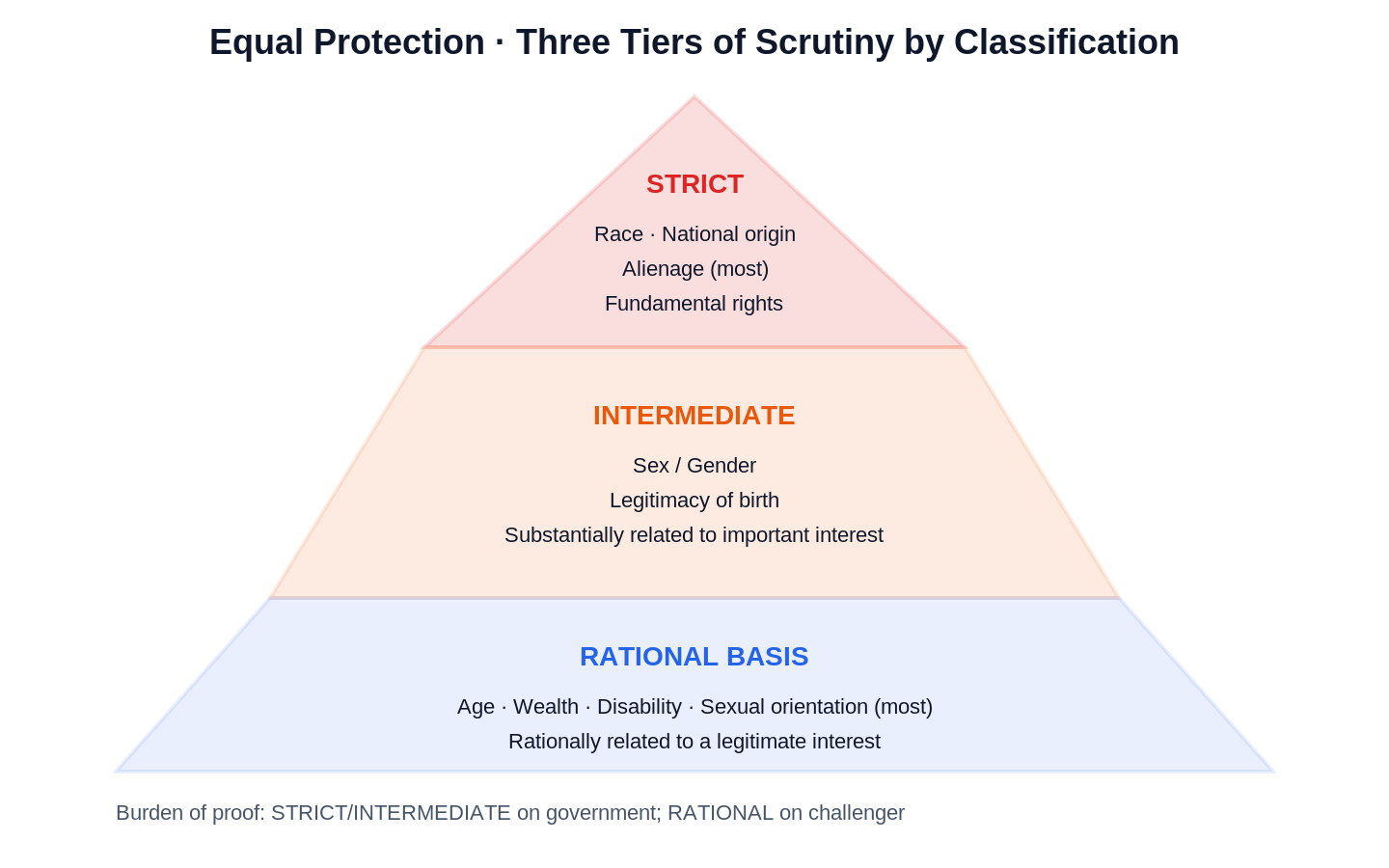
Issue. Does the government's classification deny equal protection — and what level of scrutiny applies?
這一課問的是:政府之分類是否違反平等保護 — 適用哪個審查層級?
Core Terminology · 7 must-know
Tap a card to flip and reveal the meaning.
equal protection
Tap to see meaning
No state shall deny any person equal protection of the laws (14th Am).
平等保護。
strict scrutiny
Tap to see meaning
Suspect classifications (race, national origin, alienage) + fundamental rights.
嚴格審查(種族、原籍、外籍 + 根本權利)。
intermediate scrutiny
Tap to see meaning
Quasi-suspect (gender, illegitimacy) — substantially related to important interest.
中度審查(性別、非婚生子)。
rational basis
Tap to see meaning
Default tier — rationally related to legitimate interest.
合理依據(默認)。
discriminatory intent
Tap to see meaning
Required to trigger strict scrutiny; impact alone insufficient.
歧視意圖。
facial discrimination
Tap to see meaning
Statute discriminates on its face.
表面歧視。
disparate impact
Tap to see meaning
Statute neutral on face but burdens protected class.
差別影響。
Issue · what this lesson is really about
Does the government's classification deny equal protection — and what level of scrutiny applies?
這一課問的是:政府之分類是否違反平等保護 — 適用哪個審查層級?
Trigger words & phrases that should flag this issue:
racegenderalienageclassificationdiscriminationdisparate impact
Expression Bank · how lawyers actually say it
Six function → sentence patterns. Use these in essay applications.
| Function | English sentence | 中文 |
|---|---|---|
| Classify | The classification is [suspect / quasi-suspect / non-suspect]. | 分類為 [嫌疑 / 准嫌疑 / 一般]。 |
| Apply tier | Strict / intermediate / rational basis scrutiny applies. | 適用 [嚴格 / 中度 / 合理依據]。 |
| Apply intent | Discriminatory intent is required; impact alone does not trigger strict scrutiny. | 須有歧視意圖;單純影響不足。 |
| State result | The classification fails / survives scrutiny. | 本分類 不通過 / 通過 審查。 |
Rule Sentence · the workhorse
Government classifications must comply with the Equal Protection Clause: suspect classifications (race, national origin) and infringements of fundamental rights face strict scrutiny; quasi-suspect classifications (gender, illegitimacy) face intermediate scrutiny; other classifications face rational-basis review.
Sentence Anatomy · 5 roles, 5 colors
Every rule sentence breaks into five visual roles.
Actor 行為人government政府
Act 行為classifying persons分類人
Object 對象race / gender / other characteristic種族/性別/其他特徵
Standard 法律標準tiered scrutiny層級審查
Consequence 後果classification upheld or struck分類維持或廢棄
Casebook Snapshot · a real American case
Loving v. Virginia
Holding. Virginia's law prohibiting interracial marriage violated the Equal Protection Clause because it was a racial classification subject to strict scrutiny — the State could show no compelling justification — and also violated substantive due process by infringing the fundamental right to marry. The Court rejected the State's "equal application" argument.
Why it matters. Race-based classifications get strict scrutiny no matter how the state frames the burden. Equal-application arguments don't save racial laws.
種族分類嚴格審查;不接受「對兩方均同樣適用」之辯護。
Common Mistakes · what trips students
✗ disparate impact 自動觸發 strict scrutiny。
✓ Intent required (Washington v. Davis).
須意圖(Washington v. Davis)。
✗ rational basis 等於必過。
✓ Animus-based laws fail RB.
懷有歧視之法可不過。
✗ gender 為 strict suspect。
✓ Gender is quasi-suspect (intermediate).
性別屬准嫌疑。
Mini IRAC · build the Application
Issue. Does a state statute denying driver's licenses to undocumented immigrants violate the Equal Protection Clause?
Rule. Alienage-based classifications by state government generally trigger strict scrutiny under the Equal Protection Clause.
Application (model). The state's statute denies driver's licenses solely on the basis of immigration status. Because state alienage classifications generally trigger strict scrutiny — narrowly tailored to a compelling state interest — the fact that the state's articulated interests in road safety and identity verification can be served by less restrictive means (such as licenses with limited use) means the statute is not narrowly tailored.
Pick the right element for each blank:
g1.
g2.
g3.
Conclusion. Therefore, the statute fails strict scrutiny and violates the Equal Protection Clause.
MBE Check · multiple choice
A state law sets the drinking age at 21 for men but 18 for women. Which standard applies, and what is the result?
Mini Essay · write the Application paragraph
Facts. A city ordinance requires Spanish-language religious gatherings of more than 25 persons to obtain a special permit. English-language religious gatherings of identical size are not required to obtain any permit. Members of the affected church sue.
Call. Does the ordinance violate the Equal Protection Clause?
Practice Drill · tap to build the rule
Drop the chips here in correct order:
Tap chips to add → tap chips in the target to remove: