
Estates in Land & Future Interests
← Previous lesson
Next lesson →
Real Property · Lesson 01
Estates in Land & Future Interests
這一課問的是:授予人到底「給」出去了什麼產權(fee simple absolute?defeasible?life estate?)?「留」下了什麼未來權益(reversion / remainder / executory interest)?
Actor
Act
Object
Standard
Consequence
Visual Scene · the picture in your head
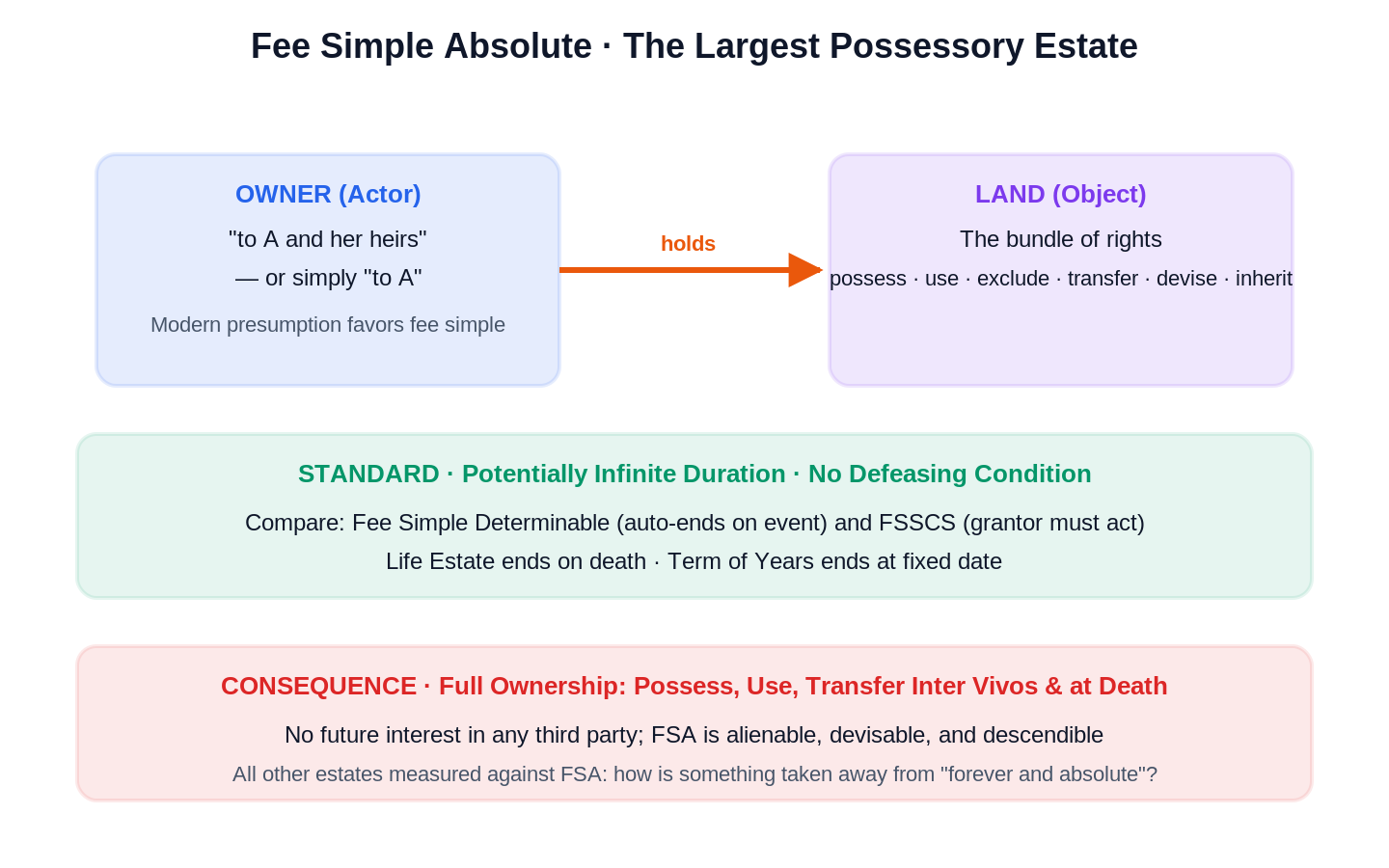
Issue. What estate did the grantor convey — and what future interest, if any, did the grantor or a third person retain?
這一課問的是:授予人到底「給」出去了什麼產權(fee simple absolute?defeasible?life estate?)?「留」下了什麼未來權益(reversion / remainder / executory interest)?
Core Terminology · 7 must-know
Tap a card to flip and reveal the meaning.
fee simple absolute
Tap to see meaning
Largest possible estate; "to A" or "to A and his heirs."
完全所有權:最大產權。
fee simple determinable
Tap to see meaning
Ends automatically upon a stated event; words: "so long as," "until," "while."
可決定限定產權:條件發生即自動終止。
fee simple subject to condition subsequent
Tap to see meaning
Grantor must act to terminate; words: "but if," "provided that."
附後條件之限定產權。
life estate
Tap to see meaning
Estate measured by a life — usually the grantee's.
終身產權。
reversion
Tap to see meaning
Future interest retained by grantor when grantor conveys less than fee.
回歸權:授予人留下之未來權益。
remainder
Tap to see meaning
Future interest in a third party that becomes possessory naturally at end of prior estate.
剩餘權。
executory interest
Tap to see meaning
Future interest in a third party that cuts short or follows a gap.
附帶權益:截斷前一估產。
Issue · what this lesson is really about
What estate did the grantor convey — and what future interest, if any, did the grantor or a third person retain?
這一課問的是:授予人到底「給」出去了什麼產權(fee simple absolute?defeasible?life estate?)?「留」下了什麼未來權益(reversion / remainder / executory interest)?
Trigger words & phrases that should flag this issue:
to A and his heirsto A for lifeso long ason condition thatbut ifthen to B
Expression Bank · how lawyers actually say it
Six function → sentence patterns. Use these in essay applications.
| Function | English sentence | 中文 |
|---|---|---|
| Classify estate | The grantor conveyed a [fee simple determinable]. | 授予人授予 [可決定限定產權]。 |
| Identify words | The conveyance used the durational language "so long as," creating an automatic terminating estate. | 用詞 "so long as" 為自動終止之語。 |
| Identify retained interest | Because the estate may end, the grantor retained a [possibility of reverter]. | 因產權可能終止,授予人留下 [回歸可能]。 |
| Identify third-party interest | The interest in B is a [vested remainder / executory interest] because [reason]. | B 之權益為 [既得剩餘權 / 附帶權益],因 [理由]。 |
| Run RAP check | An executory interest must vest within lives in being plus 21 years. | 附帶權益須於現存生命 + 21 年內既得。 |
| State result | Therefore A holds [estate] and the future interest is [interest]. | 因此 A 持有 [產權],未來權益為 [權益]。 |
Rule Sentence · the workhorse
A grantor's estate language determines what present estate the grantee holds and what future interest, if any, remains in the grantor or vests in a third party.
Sentence Anatomy · 5 roles, 5 colors
Every rule sentence breaks into five visual roles.
Actor 行為人the grantor授予人
Act 行為conveying with specific words以特定用詞授予
Object 對象an estate in land土地產權
Standard 法律標準traditional classification of estates傳統產權分類
Consequence 後果present estate + identified future interest現產權 + 未來權益
Casebook Snapshot · a real American case
Mahrenholz v. County Board of School Trustees
Holding. Where a deed conveys land "to be used for school purpose only; otherwise to revert to grantors," the durational "only" language plus automatic revert language creates a fee simple determinable with a possibility of reverter — not a fee simple subject to condition subsequent. The grantor's heirs took automatically upon cessation of school use.
Why it matters. Tiny shifts in language change which estate is created and how it ends — automatically (FSD) or only on the grantor's election (FSSCS).
Mahrenholz:用詞「only…otherwise revert」為 FSD,自動終止。
Common Mistakes · what trips students
✗ 「to A and his heirs」表示 A 與 A 的繼承人共有。
✓ Words of inheritance create fee simple in A alone; "heirs" are words of limitation, not purchase.
"and his heirs" 為限制語,不予 A 之繼承人任何現權。
✗ fee simple determinable 與 fee simple subject to condition subsequent 規則相同。
✓ FSD ends automatically; FSSCS requires grantor to exercise right of entry.
FSD 自動終止;FSSCS 需授予人行使收回權。
✗ life estate 持有人可任意處分。
✓ Life tenant has duty not to commit waste.
終身產權人有不得浪費義務。
✗ remainder 一定是 vested。
✓ Remainder may be vested or contingent — turns on whether takers are ascertained and no condition precedent.
剩餘權可為 vested 或 contingent。
Mini IRAC · build the Application
Issue. What present estate did A receive, and what future interest, if any, did the grantor retain, when O conveyed "to A and his heirs so long as the land is used for residential purposes"?
Rule. Durational language such as "so long as" creates a fee simple determinable, with the grantor retaining a possibility of reverter.
Application (model). O's deed conveyed to A "and his heirs so long as the land is used for residential purposes." Because the phrase "so long as" is classic durational language that creates a fee simple determinable, the fact that the estate continues only while the residential use lasts means O retained a possibility of reverter that would vest automatically if the use ever ceased.
Pick the right element for each blank:
g1.
g2.
g3.
Conclusion. Therefore, A holds a fee simple determinable, and O holds a possibility of reverter.
MBE Check · multiple choice
O conveys Blackacre "to A for life, then to B and her heirs." What does B hold?
Mini Essay · write the Application paragraph
Facts. In 1990 O conveyed Blackacre "to A for life, then to B if B reaches age 21, but if B does not reach 21, then to C." In 1990 B was 5 years old; A is still alive today; B is now 22.
Call. What interests did A, B, and C hold immediately after the 1990 conveyance, and what does each party hold today?
Practice Drill · tap to build the rule
Drop the chips here in correct order:
Tap chips to add → tap chips in the target to remove: