
Confidentiality & Privilege
9-Step Guided Lesson · ~10 min
Confidentiality & Privilege
Two distinct protections — one ethical, one evidentiary
律師的兩個保密義務 —— 一個倫理(MR 1.6),一個證據規則(律師-客戶特權)。範圍不同,例外也不同。
Lawyer
Protects or discloses
Client information
MR 1.6 + exceptions
Protected silence or permitted disclosure
Two distinct protections
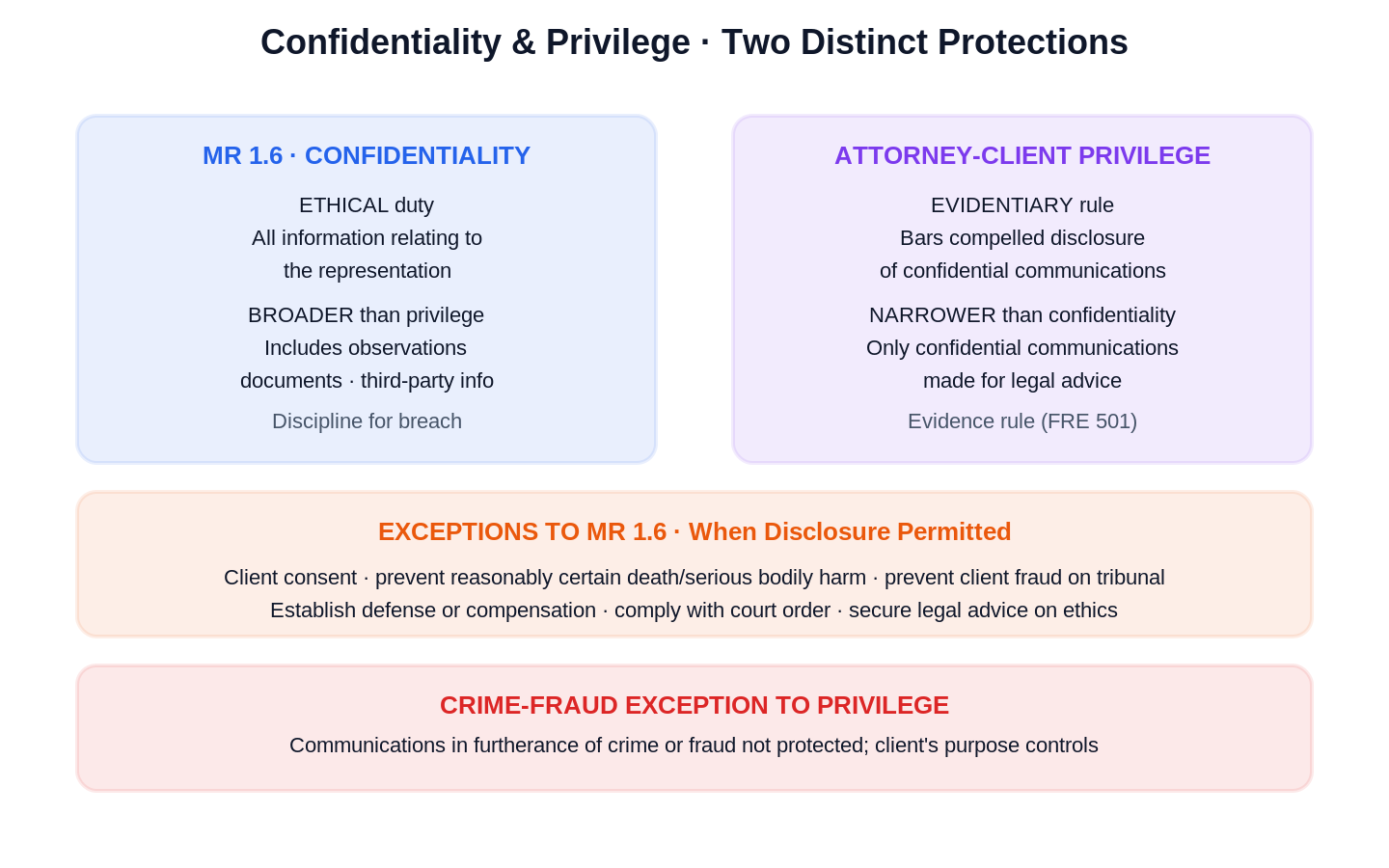
MR 1.6 Confidentiality is an ethical duty — covers ALL information relating to the representation.
Attorney-Client Privilege is an evidentiary rule — bars compelled disclosure of confidential communications for legal advice.
機密義務範圍廣(倫理);律師-客戶特權範圍窄(證據法)。
Attorney-Client Privilege is an evidentiary rule — bars compelled disclosure of confidential communications for legal advice.
機密義務範圍廣(倫理);律師-客戶特權範圍窄(證據法)。
Seven words you must own
Tap a card to flip it.
One exam-ready rule
Under MR 1.6, a lawyer must not reveal information relating to the representation of a client without informed consent, unless an exception applies — preventing reasonably certain death/SBH, preventing client fraud, mitigating injury, obtaining ethics advice, establishing claim or defense, complying with law/order, or detecting conflicts.
Source: ABA Model Rule 1.6.
Five colored parts — always
Actor 行為人
the lawyer
律師
Act 行為
protects or discloses
保護或揭露
Object 對象
client information
客戶資訊
Standard 標準
MR 1.6 broad duty + narrow exceptions
MR 1.6 廣義義務 + 狹義例外
Consequence 後果
silence required, or disclosure permitted
須保密,或可揭露
How courts illustrate this
Spaulding v. Zimmerman
Simplified Holding
Where defense counsel's medical examination revealed a life-threatening aortic aneurysm caused by the accident — unknown to the plaintiff — the court set aside the settlement. Today, under MR 1.6(b)(1)'s exception for preventing reasonably certain death, disclosure would be permitted.
Why It Matters Here
Modern rules permit (but do not require) disclosure to prevent reasonably certain death or serious bodily harm.
Your first analysis
Issue
May a lawyer reveal that her client intends to bomb a public building tomorrow?
Rule
MR 1.6(b)(1) permits — but does not require — a lawyer to reveal information to prevent reasonably certain death or substantial bodily harm.
Application
The client's planned bombing would cause
.
Because MR 1.6(b)(1) explicitly permits disclosure to prevent such harm,
.
Conclusion
Therefore,
.
One quick multiple-choice check
A client tells her lawyer that she committed a murder ten years ago — a crime now under investigation, with another defendant about to be wrongly convicted. The lawyer wants to disclose. Under MR 1.6, may she?
Lock it in — rebuild the rule
Tap the chips in the right order: